
Platform
How Recondora works
Why reconciliation needs one platform, and the five steps Recondora takes from the first file to the last approval.
The problem
Payments went digital. Reconciliation stayed in spreadsheets.
85% of Saudi retail payments in 2025 (SAMA) and 88% of Pakistani retail transactions in FY25 (SBP) were digital, and Bangladesh processed 5.46 billion digital transactions in 2025 (Bangladesh Bank). Every one of them has to be proved across switch, scheme, core banking and ledger. Teams still reconcile rail by rail in spreadsheets and point tools, find breaks days late and assemble evidence by hand for every audit.
Breaks found late
Amount differences show up as two unmatched rows, timeouts and reversals are tracked by e-mail, and suspense ages unseen.
Control by trust, not design
The same person can prepare and approve a write-off, and nobody can prove afterwards who changed what.
Evidence assembled for every audit
Files sit in shared folders, screens are pasted into reports, and every inspection starts with a search.
How it works
Ingest, match, investigate, approve, prove.
- Ingest every source in its own format: switch, scheme, core, channel and ERP files, uploaded, collected or streamed.
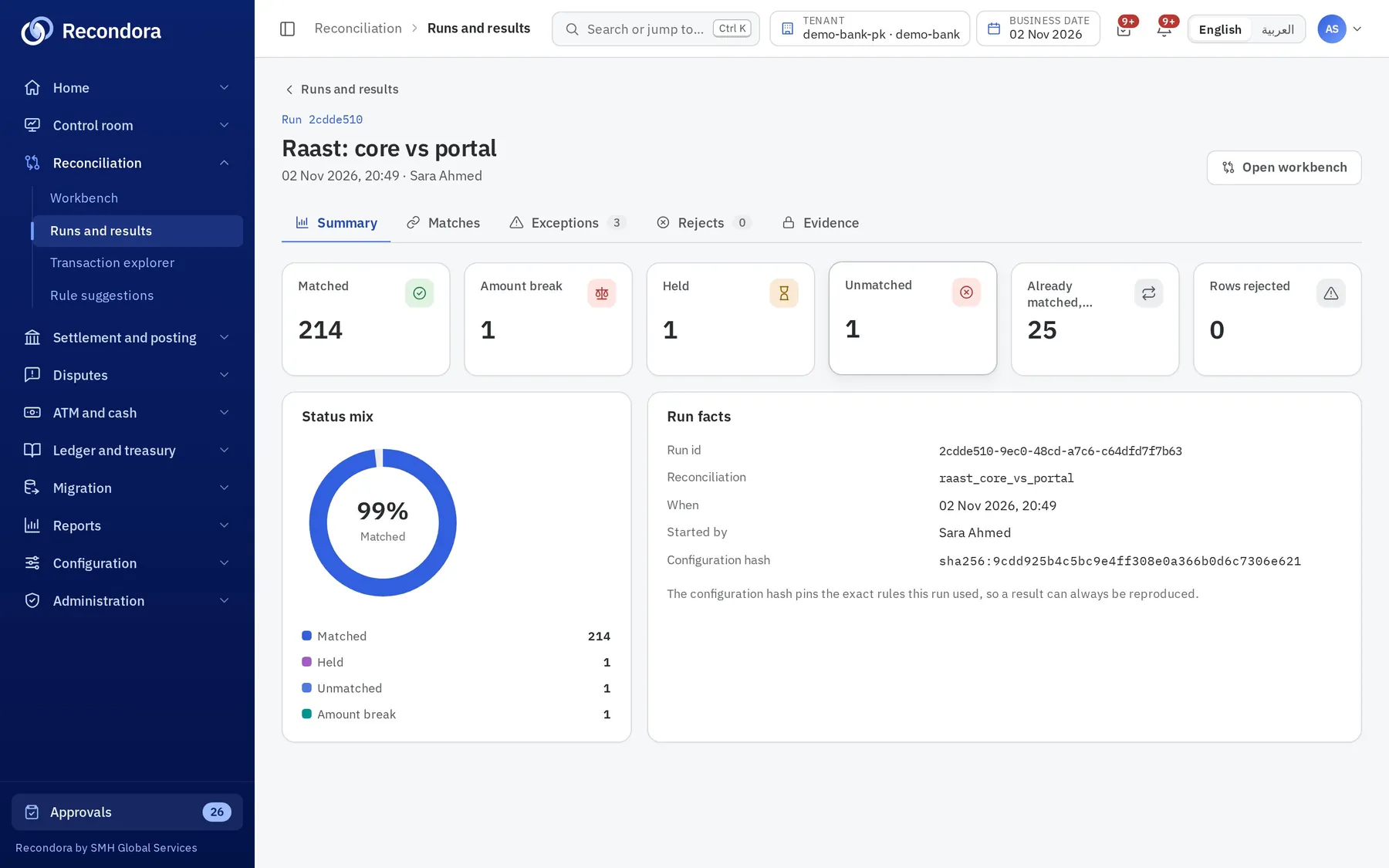
- Match with rules from configuration: keys, tolerances, hold windows and batch sums. Runs are repeatable and record their configuration.
- Investigate every break in one queue with ageing, filters and evidence.
- Approve force matches, closures and write-offs through a maker and a different checker, enforced by the server.
- Prove every number: hashed evidence on write-once storage and an audit log in which each entry seals the one before.
See it with your own files.
Book a walkthrough: we load sample files from two of your rails, run them through Recondora and show you every match, break and approval.